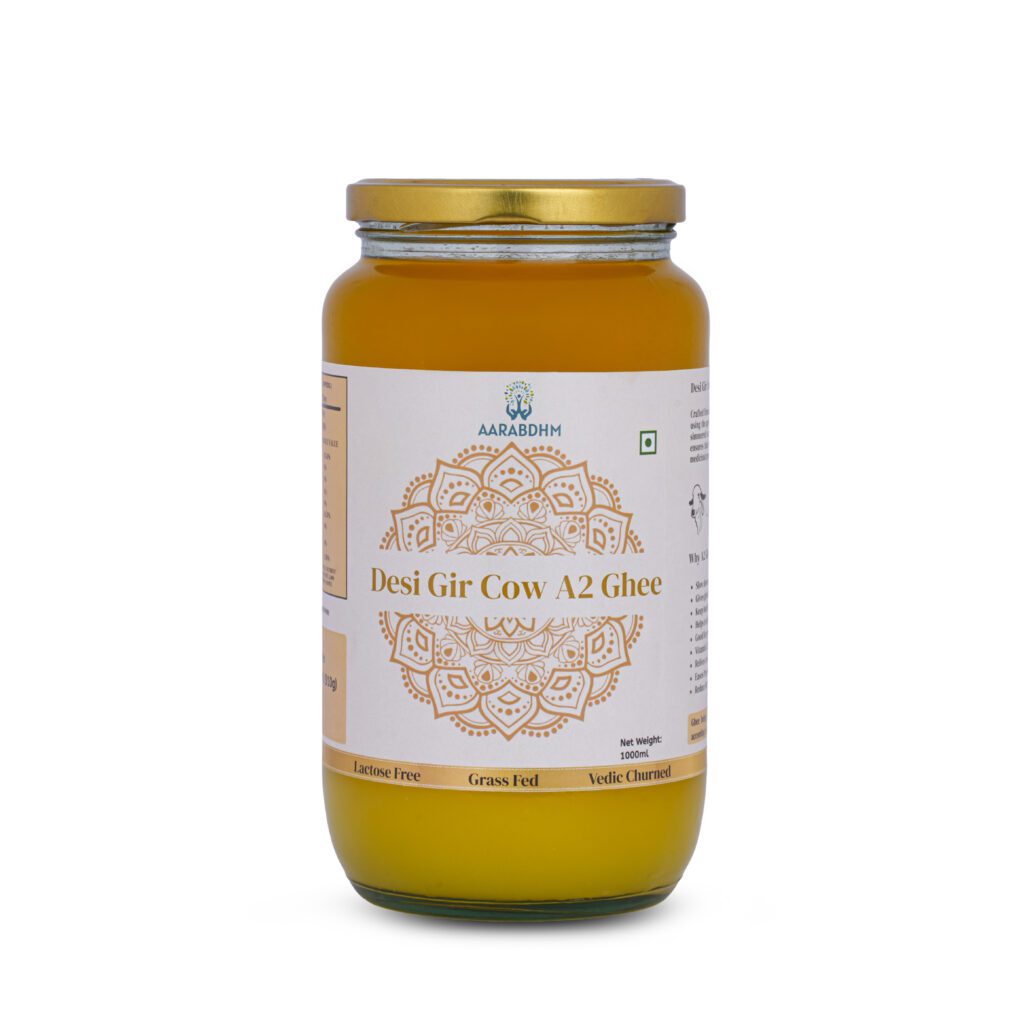
Ghee has been a cherished part of Indian kitchens for centuries. From adding a spoonful to dal and khichdi to using it in traditional sweets and everyday cooking, ghee is valued for its rich aroma, taste and versatility.
But today, you may come across terms like A2 Gir Cow Ghee, Desi Cow Ghee, Bilona Ghee and Cultured Ghee. So, what actually makes A2 Gir Cow Ghee different from regular ghee?
Let’s understand the difference.
What Is A2 Gir Cow Ghee?
A2 Gir Cow Ghee is ghee made from the milk of Gir cows, an indigenous Indian cattle breed.
The term “A2” refers to the type of beta-casein protein naturally present in the milk, while “Gir” refers to the cattle breed. Importantly, the A2 protein is present in the milk—not in the finished ghee, because ghee is almost entirely milk fat and contains very little protein.
For a traditional product like AARABDHM A2 Gir Cow Ghee, the story goes beyond the label. The breed, milk sourcing, culturing process and traditional preparation method all contribute to the character of the final product.
- Indigenous Gir Cow Milk
One of the key differences is the source of milk.
Gir cows are an indigenous Indian breed traditionally associated with Gujarat and other parts of India. A2 Gir Cow Ghee is specifically made using milk from Gir cows.
Regular ghee, on the other hand, may be made from milk obtained from different cattle breeds or from mixed milk sources, depending on the manufacturer.
Source matters because the quality and characteristics of milk can vary with breed, feed, farming practices and processing.
- Traditional Bilona Method
Not every A2 ghee is necessarily made using the Bilona method.
In the traditional Bilona process, milk is first converted into curd. The curd is then churned to separate butter, and the butter is slowly heated to produce ghee.
This is different from many commercial processes where cream is separated from milk and then processed into butter and ghee on a larger industrial scale.
The Bilona method is valued for its traditional character, distinctive aroma and rich, grainy texture.
- Curd-Cultured vs Cream-Based Ghee
This is an important distinction when comparing ghee products.
Traditional curd-cultured process:
Milk → Curd → Churning → Butter → Ghee
Common cream-based process:
Milk → Cream → Butter → Ghee
Both processes produce ghee, but they are not the same manufacturing approach.
Curd culturing introduces a fermentation step before churning, which can influence the flavour and aroma of the finished ghee.
- Rich Aroma and Distinctive Taste
Good ghee is more than just cooking fat—it is an experience of aroma and flavour.
Traditional A2 Gir Cow Ghee can have a characteristic nutty aroma, rich flavour and naturally grainy texture, particularly when prepared using cultured butter and traditional slow heating.
The final taste can vary depending on the milk, feed, season, processing method and storage conditions.
That is why two ghee products can look similar but taste noticeably different.
- Naturally Concentrated Milk Fat
Ghee is essentially clarified butter. During preparation, water and most milk solids are removed, leaving behind concentrated milk fat.
This gives ghee several practical advantages in the kitchen:
- Suitable for cooking and sautéing
- Adds richness and aroma to food
- Works beautifully in traditional Indian recipes
- Can be stored properly for extended periods
- A little can add significant flavour to a meal
However, ghee is still a high-fat food, so portion size matters as part of a balanced diet.
- Traditional Food Meets Modern Lifestyle
Today’s food choices are increasingly influenced by questions such as:
Where did this product come from?
What ingredients were used?
How was it made?
Was the traditional process preserved?
This is where traditionally prepared A2 Gir Cow Ghee appeals to consumers who want to reconnect with traditional Indian foods.
Instead of simply looking for “ghee,” consumers are increasingly interested in breed, sourcing, processing, transparency and authenticity.
A2 Gir Cow Ghee vs Regular Ghee
Feature| A2 Gir Cow Ghee| Regular Ghee
Milk source| Specifically Gir cow milk| May come from various milk sources
Breed| Indigenous Gir cattle| Depends on manufacturer
A2 terminology| Associated with A2 milk from Gir cows| Not necessarily specified
Processing| May be Bilona/curd cultured| Often varies by manufacturer
Fermentation| Traditional versions use curd culturing| Depends on process
Flavour| Often rich and aromatic| Varies widely
Texture| Can be naturally grainy| Depends on processing
Main ingredient| Milk fat| Milk fat
The biggest takeaway: “A2” and “Bilona” are not interchangeable terms. A ghee can be made from A2 milk without being Bilona-made, and a traditional Bilona process does not by itself prove that the milk came from Gir cows.
How to Choose a Good A2 Gir Cow Ghee
Before buying, don’t look only at the words printed on the front of the jar.
Check:
✔️ Milk source
Look for clear information about the cattle breed and milk sourcing.
✔️ Manufacturing process
If Bilona or curd-cultured ghee is claimed, check whether the manufacturer explains the process.
✔️ Ingredient list
A good ghee product should clearly state what it contains.
✔️ Transparency
Look for information about manufacturing, quality testing, packaging and traceability.
✔️ Taste and aroma
Authentic ghee should have a pleasant, characteristic dairy and nutty aroma rather than an artificial smell.
Why AARABDHM A2 Gir Cow Ghee?
At AARABDHM, our approach is rooted in the idea that traditional foods deserve attention to their source and preparation.
Our A2 Gir Cow Ghee is positioned around the qualities consumers increasingly look for: Gir cow milk, traditional preparation, rich aroma and an authentic ghee experience.
We believe that food should not only taste good—it should also tell you where it comes from and how it was made.
A2 Gir Cow Ghee isn’t simply “regular ghee with a premium label.”
The potential differences begin with the milk source and breed, and may extend to the culturing, churning and clarification process used to make the ghee.
If you are comparing ghee products, look beyond marketing terms. Understand the source, process, ingredients and quality standards before making your choice.
For those who appreciate traditional Indian foods and want to bring the richness of traditionally prepared ghee into their everyday meals, A2 Gir Cow Ghee can be a delicious addition to a balanced lifestyle.
AARABDHM — Bringing Traditional Goodness to the Modern Kitchen
Explore AARABDHM A2 Gir Cow Ghee
🌐 www.aarabdhm.com
📞 9649709900
AARABDHM #A2GirCowGhee #GirCowGhee #BilonaGhee #CowGhee #DesiCowGhee #CurdCulturedGhee #TraditionalFood #IndianFood #HealthyLifestyle #TraditionalGhee #PureGhee #Patna #bengaluru